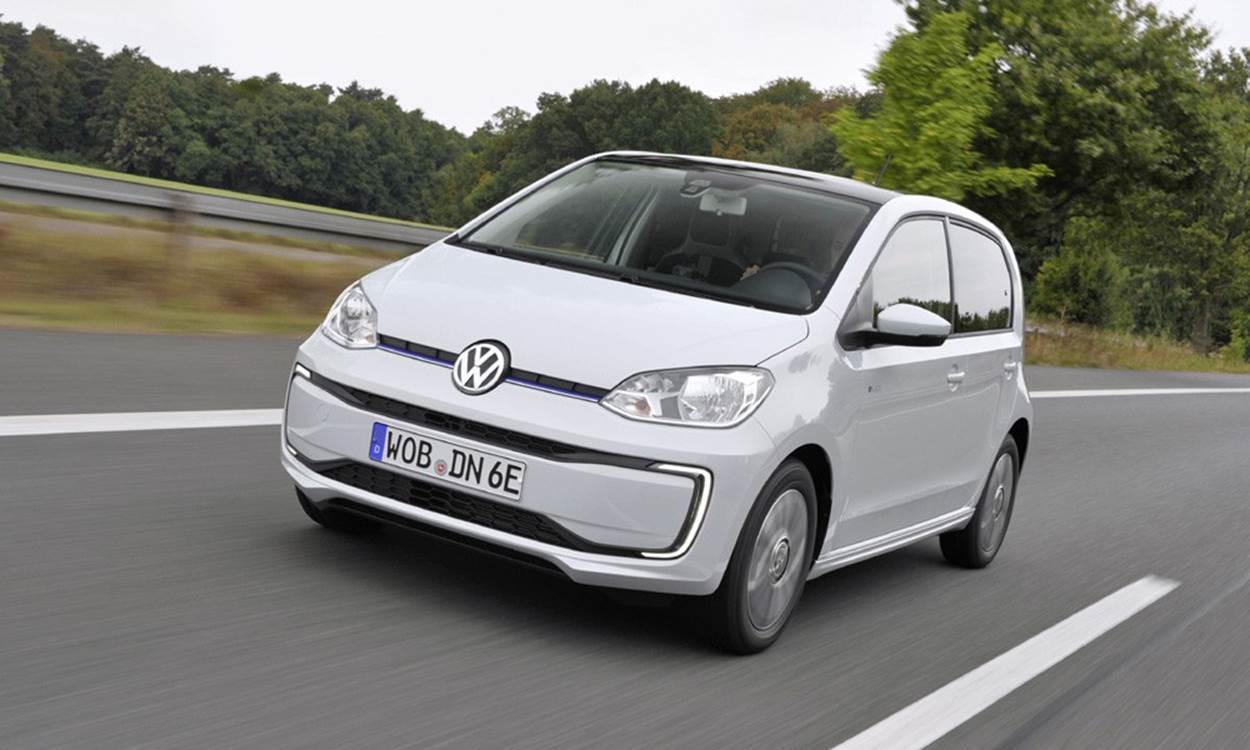
VW e-up!
Review
Almost everything we like about the Up, but unpretentiously electric. Could be the ideal first EV
The all-electric version of the Volkswagen Up, which is the best city car you can buy. The e-Up is also one of the three VW Group city car clones – you can buy an electric Skoda called the Citigo i-EV, or a Seat Mii Electric, sharing exactly the same powertrain. Said powertrain is much improved since we first copped the e-Up way back in 2013. Then, it made do with an 18.8kWh battery, and a best-case scenario range of 190 kms – on the old NEDC test. Best of luck with that. Fast-forward to 2020 and the e-Up’s batteries are much more power-dense, and only a smidge heavier. Battery capacity has doubled, to a Mini Electric-matching 32.2kWh, and claimed range on the far less optimistic but still a bit fanciful WLTP range test is a heady 260 kms. The trendier, much pricier Honda e and Mini Electric can’t get within 30 kilometes of that, even with a downhill head-start. And a tailwind. There’s only one powertrain available: an 82bhp motor driving the front wheels, and only one trim level, which makes life easier. However, if you were hoping to do without some toys and save some money, bad news. There really aren’t many toys, and the price is substantial: just over 20k all in. You get five doors, aero-faced alloy wheels as standard, and a choice of seven colours but there really isn’t a lot to customise. You could of course take the step of customising the badge on the front, by buying the Skoda or Seat instead.
Driving
The e-Up’s lucky stroke in life is to be based on the best city car. The petrol VW Up is already an extremely well-engineered product. It rides extremely maturely. For a bluff-looking box, it’s reasonably quiet, even on the motorway. It has a feeling of grown-up solidity about the driving experience, and all told it’s actually better-resolved and more satisfying to drive than a fair few superminis that are supposedly from the class above. Yep, looking at you, Opel Corsa. The e-Up is ever-so-slightly less good, if you’re really into how your car handles. Though the weight is low-set, there’s a lot of it, so it feels ponderous in bends. Oddly so, like walking a border collie that’s as clumsy as a Newfoundland. You expect a little runaround like this to feel cheeky, alert and poised, but the e-Up’s not game for any kind of playtime. On the plus side, it’s more sure-footed in a crosswind, and you don’t have to manage it a lot to keep straight’n’true in your lane. Performance is leisurely, but adequate. With 82bhp on board, the power output is closer to the standard Up 1.0 petrol than the 113bhp Up GTI. Even though that urge is delivered more sharply than the petrol engine, it’s still more of a building surge than a press-and-go zoomer. That’s because while peak power is 82bhp, the car only generates that when you flatten the not-so-loud pedal. In everyday pootling, the motor develops just 54bhp. Still, that in turn means that while you’ll be winning no YouTube drag races, the e-Up finds the right balance in town. Nippy enough to hit the gaps, but not jerky or tricky to pilot smoothly. VW claims 0-100 km/h in 11.9 seconds, and the top speed’s a mere 130 km/h, but for urban dogfights, the 0-50 km/h getaway is plenty brisk enough. You can manage the performance and the braking, despite this being a basic EV. There are three driving modes: Normal, Eco (top speed of 115 km/h) and Eco Plus (now you’re limited to just 90 km/h), the latter two dumbing down the powertrain to conserve range, and even limiting the use of the air-conditioning. We found the car most preferable in Eco Mode around town – the performance is enough to stay within limits and keep up with traffic even in dual-carriageway merging, but you’re not denting the range unduly. Meanwhile, flicking the transmission lever sideways dials up the regenerative braking power from D1 to D2 or D3. We’d ignore that and just go straight for the ‘B’ setting, found by tugging the lever back. This ‘Brake’ mode gives max regen and means you barely have to touch the brakes, if you’re looking well ahead and anticipating the lights. It feels terribly virtuous, if you’re prepared to concentrate. There’s not much to distract you inside anyway. If you do need to call upon the brakes, they’re mushy underfoot and feel ever-so-slightly overawed by the e-Up’s thickset 1,235kg weight. Still, for the car’s inner-city, or even inter-village remit, they’re fine. The e-Up thrives on an everything-in-moderation mindset.
Verdict
A cynic might dismiss the e-Up as an expensive folly. Wrong. The e-Up shows the value of progress. Cheaper and better than the first e-Up, costs barely over 20k and will easily top 190 km in regular urban use and maybe more. Those stats alone make it a great engineering achievement. The fact it’s based on the unassailable king of small cars makes it an even more desirable prospect. It’s certainly a frumpier, subtler EV than a Honda e or Mini Electric or even a Renault Zoe, but there’s a huge amount to be said for VW’s ‘just a good car, but electric’ approach – it’s what made the e-Golf such a sleeper hit. It’s also kept the e-Up relevant, recommendable, and ready for a new dawn in the small car world.
Prices
| Price | with subsidy | indicative leasing price |
|---|---|---|
| from 23.300 euro | from 19.542 euro – 1,000 for withdrawal/td> | from 149 euro/month + VAT |
Gallery